NEVADA CAVE SURVEY
%20(1)_edited.png)
%20(1)_edited.png)
Explore - Study - Protect
About Nevada’s Caves, Formations, and Ecosystems
Nevada's Underground
How Nevada Caves Form
Nevada's cave landscape reflects one of the most geologically complex cave-forming environments in North America. Understanding how these caves formed is essential to understanding why they deserve such careful protection.
Hypogenic Caves:
The majority of Nevada's significant limestone cave systems — particularly across east-central Nevada — are hypogenic caves: formed not by surface water flowing downward, but by water rising from deep within the earth. This is a fundamental distinction from the cave-forming process most people are familiar with.
In hypogenic speleogenesis, groundwater charged with carbon dioxide, hydrogen sulfide, or other dissolved gases rises through fractures in carbonate bedrock from below. As this water nears the water table and mixes with oxygen, it produces carbonic or sulfuric acid — one of the most corrosive substances in nature — which aggressively dissolves the surrounding limestone from the inside out, independent of any surface drainage. The result is cave systems with distinctive morphologies: smooth ceiling domes called cupolas, rounded bubble trails etched into overhanging walls and ceilings, upward-draining ceiling tubes, and complex boneyard passages that reflect dissolution from multiple rising points simultaneously.
Lehman Caves in Great Basin National Park — Nevada's most famous and visited cave — is a world-class example of this process. Though long described simply as a "water table cave," recent geological study has reinterpreted it as a product of sulfide-rich hypogenic waters rising from deep within the Pole Canyon marble millions of years before the Snake Range fully developed into the mountains visible today. Its Gypsum Annex passage preserves some of the clearest evidence of sulfuric acid speleogenesis in the Great Basin, including gypsum crust, pseudoscallops, acid pool notches, and hollow coralloid stalagmites. Other hypogenic features — mammillaries, folia, cupolas, and boneyard passages — appear throughout the caves of the Snake Range and adjacent ranges of eastern Nevada.
Many of these caves formed 8 to 17 million years ago, deep beneath the surface, long before the current topography existed. They are geologically ancient voids that were only later exposed by tectonic uplift, erosion, and the emergence of today's mountain ranges. The beautiful calcite speleothems that decorate many of these caves — stalactites, stalagmites, shields, and flowstone — were deposited in a later, separate phase, as wetter climatic conditions during the Pleistocene drove surface water into already-existing cave passages.
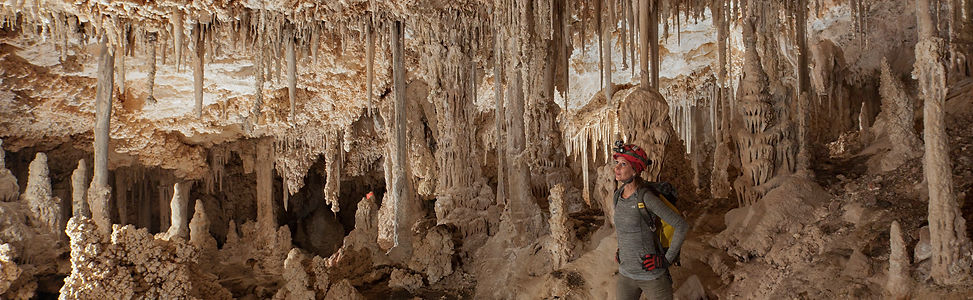
In Nevada's limestone caves, speleothems — mineral formations deposited by water — include stalactites (hanging from the ceiling), stalagmites (rising from the floor), flowstone, rimstone dams, columns, shields, cave pearls, and delicate helictites growing in seemingly impossible directions. Because many of Nevada's caves are hypogenic in origin, they also preserve a distinct class of speleogenetic features — formations that record not the dripping of surface water, but the rising of ancient acidic groundwater. Folia, mammilaries, cupolas, bubble trails, and gypsum crusts are among the diagnostic features found in Nevada's hypogenic systems. These formations are scientifically irreplaceable: they record geochemical conditions that existed millions of years ago and are actively used by researchers to reconstruct the tectonic and hydrological history of the Great Basin. Nevada's drier caves sometimes also host spectacular gypsum formations — massive gypsum flowers, gypsum crusts, and selenite crystals that are unique to arid cave environments and among the most fragile formations found anywhere underground.
Epigenic Caves
Some Nevada caves, particularly in the wetter mountain ranges of the northern and central parts of the state, formed through conventional epigenic (top-down) processes, where slightly acidic surface water percolates downward through joints and fractures in carbonate rock, slowly dissolving limestone over millions of years. Terrains shaped by this process — characterized by sinkholes, disappearing streams, and springs fed by underground drainage — are called karst. Nevada has significant karst regions. These areas are hydrologically sensitive: surface water enters the subsurface rapidly with little filtration, making cave protection directly linked to groundwater and water quality for downstream communities and wildlife.
Gypsum and Tufa Caves
Nevada's arid basin-and-range terrain also hosts gypsum caves and tufa caves, each the product of entirely different geochemical processes. Gypsum Cave near Las Vegas, listed on the National Register of Historic Places, preserved remains of Shasta ground sloths, extinct horses, and evidence of human habitation dating back thousands of years — a reminder that Nevada's caves are as important archaeologically and paleontologically as they are geologically.
Cave Characteristics in Nevada
Nevada's caves range from short, accessible rooms to multi-mile systems with complex vertical development. Many of the state's limestone caves — particularly the hypogenic systems of eastern Nevada — feature maze-like boneyard passages, large breakdown rooms created when ancient cave ceilings collapsed after the water drained away, and vertical pits ranging from a few feet to hundreds of feet deep. Some caves at higher elevations retain ice year-round.
Desert caves at lower elevations may be very dry, with extraordinarily delicate gypsum and calcite formations.
Most Nevada caves maintain temperatures closely tied to the long-term average surface temperature above them — typically ranging from the mid-40s°F in higher mountain caves to the low 60s°F in lower-desert caves. Many feel cold relative to summer surface temperatures, and airflow near entrances can create significant wind chill. Always dress for cave temperature, not outside temperature.
Speleothems: Nevada's Cave Formations
Speleothems of all types grow slowly — often a single cubic inch over thousands of years. A single careless touch deposits skin oils and sediment that permanently stain formations and may halt growth. A broken formation is gone forever. Keep hands and boots away from all formations, even those that appear already damaged. Watch your helmet and pack when moving through low-ceiling areas.
Cave Life in Nevada
Despite the apparent harshness of cave environments, Nevada's caves support a remarkable array of life — from cave-obligate invertebrates found nowhere else on Earth to migratory bats that travel thousands of miles to winter in Nevada's underground. The cave ecosystem is far more fragile than most surface ecosystems: food webs are slow, populations are small, and recovery from disturbance can take decades or never occur at all.
Always wash your caving clothing and gear thoroughly between trips. Transferring mud, spores, organic matter, or pathogens between caves — even between Nevada caves — can introduce species and diseases into cave ecosystems that have no natural defenses against them.
Cave-Obligate Species (Troglobites)
Animals that spend their entire lives underground and cannot survive outside a cave are called troglobites. Nevada harbors a number of troglobitic species, including cave-adapted amphipods, isopods, spiders, beetles, and other invertebrates — many of which are found only in a single cave or a small cluster of nearby caves. These species are often blind and depigmented, having evolved over thousands of generations without light.
Recent biological inventories in the caves of east-central Nevada have identified potential new species including a cave-adapted palpigrade — a micro whip scorpion representing the first of its kind identified in Nevada and a significant scientific discovery. Many cave biological specimens from Nevada await formal identification and description. This means the full biological significance of many Nevada caves is still unknown.
Troglobites are extremely sensitive to changes in their environment. Alterations in airflow, temperature, humidity, water chemistry, or food availability can devastate populations. Because many Nevada cave species have never been formally described by science, a single careless visit could eliminate a species before it is even known to exist. Treat every cave as if it harbors something irreplaceable — because it likely does.
Cave Visitors (Trogloxenes)
Many animals use Nevada's caves regularly but return to the surface to feed. These cave visitors — called trogloxenes — include ringtail cats, packrats, snakes, owls, swallows, and various insects. Their presence is part of the cave ecosystem: packrat middens in caves have provided scientists with priceless records of past climates and vegetation, and owl pellets and guano accumulations support entire food webs of cave invertebrates.
Avoid disturbing trogloxene animals or their nests and deposits. Packrat middens, in particular, may have scientific and archaeological significance.
Bats in Nevada
Nevada is home to approximately 23 species of bats, and the majority of them use caves or cave-like structures — abandoned mines, rock shelters, culverts — at some point in their life cycles. Bats are among Nevada's most ecologically important mammals: a single little brown bat can consume thousands of insects per night, providing natural pest control that benefits agriculture and public health across the state.
Rose Guano Cave in east-central Nevada hosts one of the largest bat concentrations in the state — between one and three million bats, predominantly Mexican free-tailed bats, use it as a migratory stop from approximately July through September each year. Nevada Department of Wildlife has conducted multi-year tagging programs there to better understand bat migration routes across the region.
Nevada's bat populations face serious and ongoing threats. White-nose syndrome (WNS), a fungal disease caused by Pseudogymnoascus destructans, has killed millions of cave-hibernating bats across North America since it was first documented in 2006. The fungus has been documented moving steadily westward and has been confirmed in Nevada. Cavers play a direct role in slowing its spread.
Nevada has bat hibernacula (winter roosts) and maternity colonies (summer birthing roosts) in caves throughout the state, many of which are protected by agency-managed gates or seasonal closures. Disturbing hibernating bats forces them to burn critical fat reserves that they may not be able to replace before insects become available in spring — a single disturbance can be fatal. Disturbing a maternity colony can cause mothers to abandon pups.
Key rules for bats in Nevada:
-
Never enter a cave that is posted as a bat hibernaculum or maternity colony without explicit written authorization from the managing agency.
-
Observe and follow all seasonal cave closures, which are posted to protect bat populations.
-
If you encounter bats while caving, quietly and slowly exit the cave and report the location and approximate numbers to the Nevada Cave Survey.
-
Follow NCS and USGS decontamination protocols for all clothing and gear that contacts cave surfaces to minimize WNS spread.
-
Report any unusual bat behavior — bats flying in daylight, clustering near entrances in cold weather, dead bats on cave floors — to Nevada Department of Wildlife or the NCS immediately.
Extremophiles and Microbial Life
Nevada's caves — particularly those with unique chemistries rooted in their hypogenic origins — may harbor communities of microorganisms that derive energy from mineral reactions rather than sunlight. These chemosynthetic microbial communities are scientifically significant, with implications for understanding the origins of life and the possibility of life in other planetary environments. The secondary mineral deposits in caves like Lehman are actively studied for microbial associations that may reflect the cave's ancient sulfuric acid history. Avoid touching cave walls, floors, and pools unnecessarily — even clean hands can disrupt microbial communities that took thousands of years to establish.